Music Journal
voice memos attached to songs, tested well conceptually, but users couldn’t define when they’d use it. It didn’t drive repeat engagement.
Winner - Amazon Music Design Challenge 2025
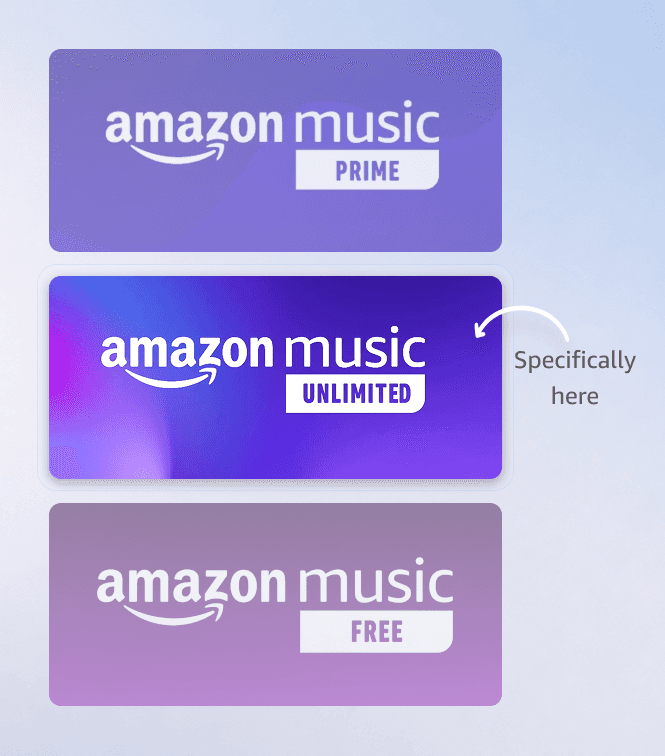
Amazon Music had a problem most apps would envy: 85 million users who came free with Prime. The brief asked us to keep them.
I owned Suggestion Modes end-to-end and shaped the strategy, tier logic, and points system for Rewards & Loyalty. This case study is how a four-week sprint turned a retention brief into a tier-upgrade strategy and what I'd do next if it shipped.

I was one of four designers on 565 Collective. Specifically, I:
Ran 20 of the 50 user interviews: wrote the discussion guide, recruited participants across two age brackets (20–35 and 35–50), moderated every session I ran, and synthesized findings with the team into affinity clusters.
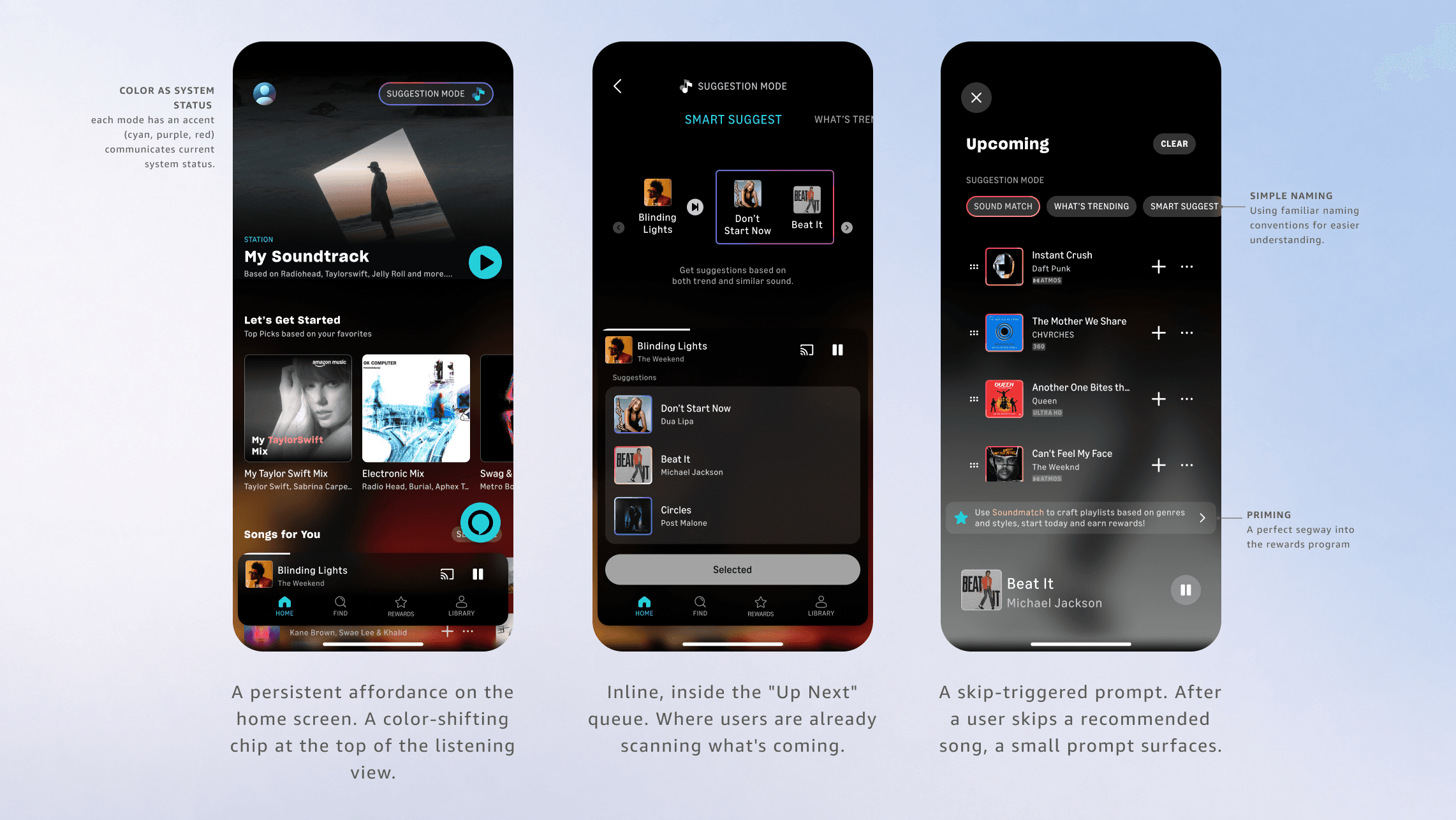
Owned Suggestion Modes end-to-end: from concept, to the three-mode architecture, to the two-touchpoint placement strategy, to hi-fi Figma prototype.
Killed two directions in Phase IV: I argued to drop Music Journal and Mood Concept against the team's three-way filter (people / business / technology). Neither passed.
Co-presented at Amazon HQ: walked Amazon Music's Head of Design and Director of Product through the Suggestion Modes rationale live.
Push notifications. Streaks. Daily playlists. We almost went down that road. The interviews redirected us.
What kept surfacing wasn't that users were leaving it was that they'd never emotionally arrived. Spotify had Wrapped. Apple Music had editorial. Amazon Music had an app that came with Prime. Functional, forgettable.
That reframed the question. Retention wasn't the design problem. Ownership was. Users who feel no agency over a product cancel it the moment a bundle ends. Users who feel some don't.
We ran 50 interviews across four streaming platforms and two age groups (20–35, 35–50). I personally moderated 20 of those sessions and led the affinity synthesis with the team. The discussion guide was structured around three things: what users actually do during a listening session, where the experience breaks for them, and what they wish they could control.

The distrust finding was the surprise. We expected complaints about catalog, pricing, or interface. What we got instead was a consistent, almost universal frustration with the recommendation engine itself and a sense that users were guessing at how to game it (skip more, like more, save to playlist) rather than directly shaping it.
We started Phase IV with four feature directions. By the end of the week we were down to two. I argued to cut Music Journal and Mood Concept early and the cuts were clean once we filtered each idea through three questions: does it solve a real user problem, does it support the business model, and can we actually build it.
Three modes, mapped directly to how the algorithm already works
The leverage of this design is what it doesn't require. No new ML investment, no retraining, no model changes. The recommendation engine already produces both signals, Suggestion Modes is a routing decision on top of work Amazon already does. A one-sprint feature, not a one-quarter rebuild. Part of why Amazon's leadership engaged with it as a serious proposal rather than a student concept.
Suggestion Modes solved for in-session ownership. Rewards & Loyalty solved for between-session reasons to come back, same strategic answer, different time horizon.
The thesis was specific to Amazon. No other streaming competitor sits inside an e-commerce platform with a billion product SKUs. Spotify gives users badges. Apple Music gives editorial credit. Only Amazon can give users something they actually want to own, artist merch, vinyl, exclusive drops paid for in points earned by listening.
found the placement intuitive, they discovered Suggestion Modes through both the queue and the skip prompt without being told where to look.
couldn't reliably distinguish Sound Match from Smart Suggest. "Isn't 'smart' just a better version of 'sound'?" one user asked.
Showed interest in engaging more with the app for redeeming rewards
That's a feature-education problem, not a discovery problem — and the next design problem to solve. The current onboarding explains what each mode does. It doesn't let users hear the difference. A 30-second comparative sample would.
I'd watch 30-day retention among Unlimited subscribers, segmenting engaged users (used Suggestion Modes once and earned points in week one) against passive users (did neither). My hypothesis: engaged users retain 15–20% better because both behaviors create active investment in the product, not because the modes produce better recommendations.
The experiment is the entry point. Control treats both features as discoverable. Variant introduces them as required onboarding for new Unlimited subscribers pick a mode, see your first points balance, before the first song plays. If the hypothesis holds, the right move isn't to allow engagement but to require a moment of it on day one.
I came in assuming toggles were for advanced users. The opposite is true the most casual listener is most frustrated with the algorithm, because they use it most passively. A switch didn't add complexity. It added agency