

Setting the scene
In April 2026, MIT Libraries shipped a unified search across all their databases. A year earlier, our team's research had identified the fragmentation behind their three separate search tools as the central architectural problem.
I was one of four product designers on the engagement. I owned card sorting and tree testing, competitive analysis across 20 library sites, and one of four homepage directions end-to-end.
The work didn't ship as a redesign. It shipped as the foundation for a multi-year roadmap. Universal search is the first piece to land
Tab option 1
Tab option 2
AFTER
BEFORE

The brief was a redesign. The real problem was a lost habit.
"I just Google it"
The brief said "redesign the website." Research told us the real problem: MIT Libraries had lost the "first stop" position. Users brought Google's mental model, type-scan-click, to a system built around library science.
The mismatch was so consistent that "I just Google it" became the line we kept hearing. We weren't fixing navigation. We were trying to win back a habit.
That reframe changed the engagement. The deliverable stopped being a homepage. It became a research-backed argument about where MIT Libraries fits inside a researcher's workflow.
Five methods, one pattern.
We started the research with 5 methods ran in parallel over the first three months.

Three search tools looked like one.
Bento Search
pulls from multiple databases including archives and theses.
Primo Search
pulls from a narrower catalog.
Site-Wide Search
search lacks visibility entirely.
That sentence is the engine behind "I just Google it." Google wins not on quality but on the absence of any decision before you type. MIT Libraries required users to choose a tool whose name and scope they couldn't reliably distinguish. The cost of choosing wrong was an empty result page that read as absence rather than mismatch.
Users learned the easier path. The behavior was rational.
Topical IA won 86% to 78%, with a real trade-off.
Topical won, but the trade-off was real. It aligned with mental models users brought from competitor sites: the search / services / research pattern was familiar enough that users navigated it on the first attempt.
Task-based reflected what the card sort said about user goals, but it had no precedent on any peer site. Users had no template for navigating an academic library by task, and the lack of pattern-matching cost them confidence even when they completed tasks correctly.
The choice was between a structure that matched expectations from elsewhere and one that matched goals articulated in research. The former tested better. We recommended it with the trade-off explicit.
Current IA

Topical IA
86% (+17%)
Task success rate

Task Based IA
78% (+13%)
Task success rate


Four variations, not one, the scope was exploration.
We presented four homepage variations rather than committing to one. Two IA models, not one. This was deliberate. MIT Libraries had a multi-year roadmap ahead of them. They needed strategic options to align internal stakeholders, not a single design to implement. Each variation tested a different hypothesis about what to foreground: search tools, services, research expertise, or task-oriented entry points. Each IA model tested a different mental model: competitive convention versus card-sorting findings.
The bet was that a structured set of options with research grounding would be more useful than committing to one answer prematurely. That bet held.
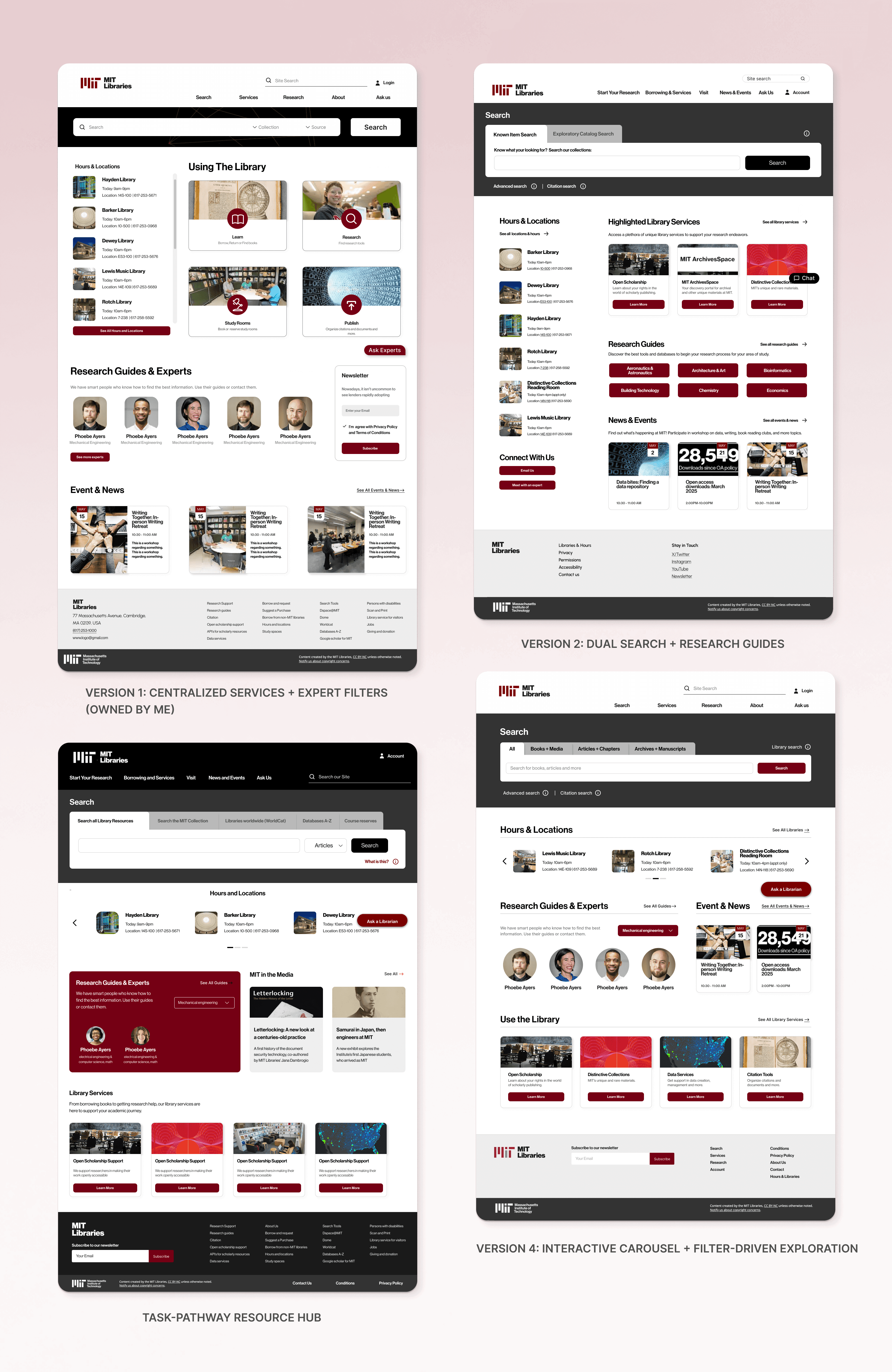

Variation 1 (mine):
Make the source-and-format choice explicit before the user types.
Bento/Primo is a confusion-before-typing problem. Users could search fine once they were searching. They got stuck choosing where. This variation pairs two dropdowns at the search bar, material format and source, so "what am I looking for, and where" gets resolved in the same gesture as the query.
Liaison interviews surfaced that staff often direct users to footer links to choose where to search. This brings that decision up front. Information-seeker interviews asked for clearer filters. The format axis is the answer.
Trade-off: choice load before typing, instead of an empty result page after. Faster than the wrong tool, slower than Google and the next thing worth testing.

Client feedback redirected the labeling work.
The MIT team flagged "Library Services" and "liaisons" as terms that might not land with general users. That feedback redirected the labeling work. We stopped optimizing for librarian-internal vocabulary and started designing for the average undergraduate.
This was the most useful piece of client feedback we received. The website was written in the language of the institution providing the service, not the language of the people using it.
"Liaisons" is precise terminology inside library science. Outside it, the word does not signal "subject expert who can help you with your thesis." What started as a labeling fix propagated into every design we made afterward.
Universal search shipped in April 2026.
In April 2026, MIT Libraries launched universal search a unified search pulling from all of their databases. The decision aligns directly with our findings on the Bento/Primo confusion. The architectural problem we identified became the first solved piece of the multi-year roadmap
Two takeaways.
Research's job is to interrogate the brief, not to validate it.
The brief asked us to redesign a website. Research told us the website was a symptom. The real problem was that MIT Libraries had lost a behavioral position inside a researcher's workflow. "I just Google it" wasn't a quote about navigation. It was a quote about institutional positioning. I read briefs as questions now, not just as inputs to the solution.
When the engagement is foundation-laying, the deliverable is the shared frame.
Four variations wasn't indecision; it was the artifact a client needed to align internal stakeholders before committing to a direction. The shared vocabulary the MIT team named as their unexpected outcome was the actual deliverable. The variations were the vehicle that produced it. The question to optimize is "what frame survives the handoff," not "which design is best." Universal search shipping a year later confirmed that a frame had survived.
Our team with the MIT Libraries UX team.


